Research has found that differential health care across rural and urban communities accounts for about 10 to 20 percent of the disparity between urban and rural health outcomes. Other social and structural factors make up the remaining 80 to 90 percent; yet they tend to receive less attention in both research and interventions.
If you are interested in being added to the SSRI Rural Health Initiative listserv about upcoming opportunities, please email Kristina Brant or Jessica Thompson.
Who We Are
 Founded in 2023, the Rural Health Initiative was the first working group established under SSRI’s new Level 1 seed grant mechanism. Our working group aims to advance research on rural population health at Penn State and leverage this research for direct impact. Through research translation and community engagement, we aim to support practitioners and communities in improving health outcomes in rural Pennsylvania.
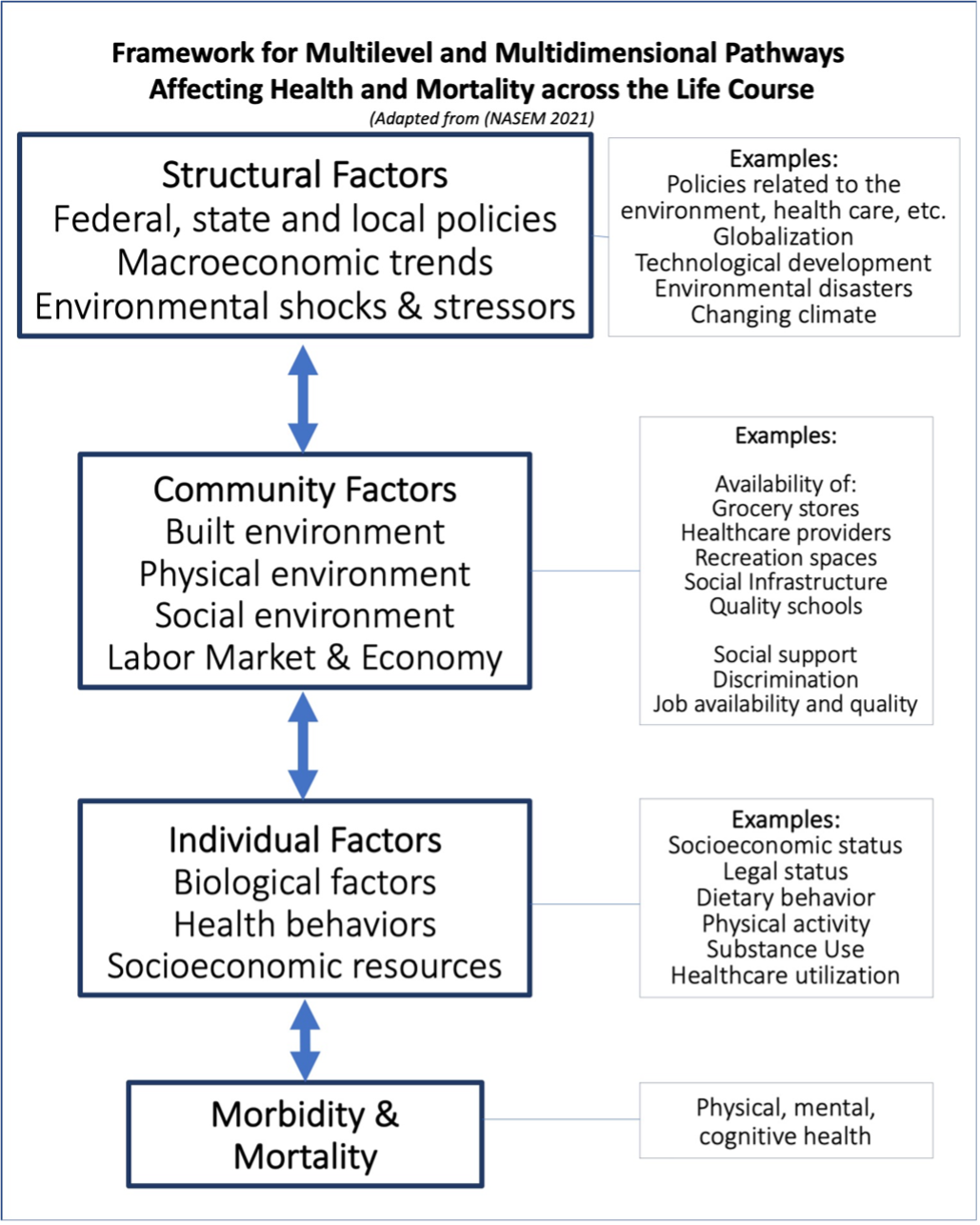
The Rural Health Initiative encourages teams to focus on these up-stream social and structural determinants of rural-urban and within-rural health disparities. To do this, we draw on an adapted framework proposed by the National Academies of Sciences, Engineering and Medicine (2021), which emphasizes the important role of structural determinants of health (e.g. policies, macroeconomic contexts and trends, climate change), community determinants of health (e.g. social, family, work, and physical and built environments), as well as individual determinants of health (e.g. biological function, health behaviors, socioeconomic resources, and health care use). We also recognize that interdisciplinary teams that draw on both the social and physical sciences are essential for understanding the multilevel and multidimensional pathways affecting health and mortality for rural populations.
Steering Committee
Group Leads:
Kristina Brant, Assistant Professor of Rural Sociology, College of Agricultural Sciences
Jessica Thompson, Assistant Professor of Health Policy and Administration, College of Health and Human Development
Supriya Joshi, Research Project Assistant, Social Science Research Institute
Board Members:
Florence Becot, Nationwide Insurance Early Career Professor, College of Agricultural Sciences
Louisa Holmes, Associate Professor of Geography and Demography, College of Earth and Mineral Sciences
Jennifer Moss, Associate Professor of Family and Community Medicine and Public Health Sciences, College of Medicine
Danielle Rhubart, Assistant Teaching Professor of Biobehavioral Health, College of Health and Human Development
What We Do
Penn State has a wealth of researchers who study both health outcomes and determinants of health in rural communities. These researchers are scattered across colleges and campuses. The Rural Health Initiative aims to break down these silos to bring together social science researchers who study rural health and the roots of rural health disparities. The Rural Health Initiative also aims to bridge rural health researchers and educators within the Penn State community, ensuring that research and outreach arms of the university collaborate effectively to bolster the approach and success of each. Finally, the Initiative aims to develop university-community partnerships between rural researchers and practitioners, grounding Penn State research in community interests and facilitating the dissemination of research to the public.
Main Activities
- We host an annual symposium and 2-3 workshops a year that convene researchers, educators, and
practitioners to network and share current rural health research and engagement. - We support incubator efforts to connect faculty across colleges and spark new research collaborations.
- We conduct pilot studies as a working group to develop research questions and prepare competitive
proposals for extramural funding.
Planned Activities
- We are developing an external advisory board of representatives from governmental and non-governmental
organizations who address rural health and well-being. - We plan to formalize our membership base into a research group and practice group, recruiting external practitioners
who work in rural health to join our network. - We plan to develop a regular newsletter and research brief series to share information on funding opportunities,
education opportunities, and new research with our university and community members. - Ultimately, we intend to apply for extramural center-level funding to support center-based research projects that
have significant community engagement components.
Success Stories
- Kristina Brant completed a study for the Center for Rural Pennsylvania focused on rural access to medications for opioid use disorder and harm reduction< services, leading to state and local policy recommendations to reduce substance use harms.
- Jessica Thompson continues a National Cancer Institute funded study focused on using community-engaged approaches to develop a lung cancer prevention intervention for women in our rural and Appalachian communities.
- Jennifer Moss recently completed data collection for a study of healthcare access, health behaviors, and quality of life among cancer survivors from rural, impoverished communities on the Texas/Mexico border. This work extends her existing research on social and community factors impacting health outcomes for rural populations.
Highlights of the Past Year
- Needs and Assets Assessment
We are presently conducting a multi-method needs and assets assessment with rural residents, health care providers, and other social services providers to identify emerging barriers and facilitators affecting the health of rural residents in Pennsylvania. - Internal Advisory Board
We established a new internal advisory board for our Initiative including members across 6 different departments: Dr. Kristina Brant (co-chair, Rural Sociology), Dr. Jessica Thompson (co-chair, Health Policy and Administration), Dr. Florence Becot (member, Agricultural and Biological Engineering), Dr. Louisa Holmes (member, Geography and Demography), Dr. Jennifer Moss (member, Family and Community Medicine), and Dr. Danielle Rhubart (member, Biobehavioral Health). - Annual Symposium
Our most recent symposium attracted the attendance of over 40 faculty and staff to network, share current research and practice experiences, and to plan future Initiative< activities. Read a summary from the first Social Science Research on Rural Population Health Symposium held in January 2024 by clicking here.